Maybe this should be titled the “Summer Doldrums” letter, but Hello Everyone!
As summer burns (this year is a hot one), I cannot help but notice the underlying hint of autumn lurking just underneath. I guess it’s just that time.
Autumn was my favorite time growing up—and still is to this day. Somehow it brings the hint of promise that the new school year always seemed to possess. If nothing else, turning aspens always lift my spirits. For whatever the reason, a subject that keeps coming to mind is old tintypes and early photographs primarily of western characters, and “fancy” ladies of one form or another. I took out some of the photographs I have collected over the years, wondering about the lives these people lived, the places they saw, and the feelings they held. I believe I started collecting them first for writing prompts, or even as physical descriptions of characters in stories, novels, and even non-fiction.
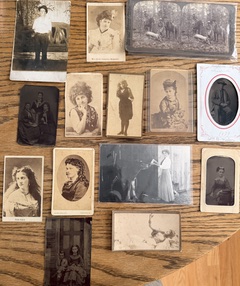
Top left to right – questionable Leadville man, Miss Helen Josephine Mansfield – Actress with a scandalous past, Women hunting elk in Wyoming, Second row – tintype of a family – three sisters wearing the same ribbon, Millie (second name illegible) Circus Performer, woman of questionable fame unnamed, Lydia Hickey (?) actress? William B. Fisher 1879 Leadville. Third Row—Rosa Rand American Actress, Denver woman (name inked out), homesteading woman Fowler, CO., tintype unknown woman, tintype of two children (rare) purchased in Cape Cod, and another actress/dramatic woman.
The latest purchase:
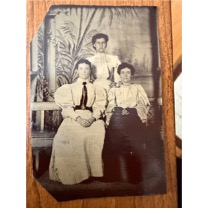
Purchased on eBay – the seller thought these ladies were prostitutes. The standing lady appears to have a bruise on her lower face; another seated on the right may have a bruise on her cheek. They may be ladies of the night . . .or they may be sisters, cousins, or friends. Tintype.
The evolution of photography runs as follows (and many of you may know this all already). The first permanent images were made by daguerreotypes began with Nicephore Niepce in 1826 or 1827. He later paired with Louis Daguerre of Daguerreotype fame. Daguerreotypes were invented in 1839. However, this early photographic process involved handling the dangerous mercury vapor, which posed severe health risks and affected the lungs, kidneys, and the nervous system. Frederick Scott Archer invented glass wet plates in 1851, and Richard Leach Maddox invented gelatin dry plates in 1871. Kodak came along in 1881.
More interesting to me, however, are the people getting their photographs taken and what those photographs meant to their loved ones. In 1851, prices ranged from fifty cents to ten dollars – $1 costing about $43.37 in 2026 currency. People in the early days did not smile due to a combination of long exposure time (smiles were hard to hold) and the cultural idea that smiling was a sign of foolishness. Then, also, there were those teeth to consider . . .
Weddings, in the early times of photography, seem to have been deemed less important than capturing the likenesses of those recently departed. Deaths was no stranger to many families in the 19th and early 20th centuries and many people – especially children – had pictures taken as a form of “memento mori” – a Latin phrase translated as “remember that you have to die.” While such photographs may strike as macabre today, at the time they provided a tangible reminder that their loved ones had once existed along with their image captured for all time.
On a happier note, getting one’s photograph taken was a huge event. Often people brought props for those photographs that displayed a message the sitter wanted to convey. For example, if the sitter held a book, it meant at the very least that they could read. It signified education, and perhaps cultural pursuits. Likewise, a violin conveyed musical ability and culture.
When the Civil War occurred in 1861, there was a rush for soldiers to get their pictures taken, followed by a wave of women in mourning clothes. Wet-plate photography was used, where an image is captured on chemically coated pieces of plate glass. This was a complicated process done exclusively by photographic professionals. Battlefields were photographed, the photographers and their assistants had to lug bulky cameras, mix the chemicals by hand using dangerous chemicals such as ethyl ether and acetic or sulfuric acid.
After the Civil War, the age of western expansion rode in. There are photographs of the West in the 1860’s, but they are RARE. Usually in museums, as a matter of fact. In the 1869, the famed William Henry Jackson (with the backing of his father) set up a studio in Omaha, Nebraska. Certainly, the West’s most famous landscape photographer, in 1871 he was invited to join Hayden’s Geologic Survey when he photographed Yellowstone. The rest, as they say, was photographic history. To the artist/author/historian Jackson’s photographs are a treasure-trove of ideas.
In some way, photographs are a window into the past like nothing else.
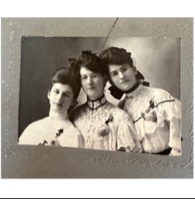
PS – my great grandmother is in the middle with a bit of a smirk!
What is upcoming?
A small collaboration with Mike Torreano! Mike had this terrific idea to write short stories about a Colt…and I’m writing one of the stories in his book. I love this idea! More about this later…but there is a reason behind why this strikes such a chord (of course there is). When the project gets nearer to completion, I’ll let you all know!
News:
Third time is the charm! The short story Death and Singular Obligations won 1st place in the Colorado Author’s League 2026 Awards.
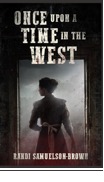
New Book — Gilpin and Cripple Creek Counties
It’s well known that the “Richest Square Mile on Earth” sparked dreams of gold and riches in the Colorado Mountains – but here are the tales of what life in gold camps were really like!
With a bang-up foreword from David Forsyth on Lou Bunch (trust me—this is the BEST that has been written), I follow up with tales of mayhem, treachery, fires…and more shady ladies.
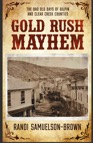
For some reason Amazon thinks this is out of print – it’s not!
Events:
September 16, 2026 – Colorado State Capital – Private Event
September 28, 2026 – Book Club – private event. Showcased book: MARKET STREET MADAM.
October 3, 2026 – State Fairgrounds, Pueblo, CO – Chuckwagon event 12:00 – 6:00.
October 21, 2026 – San Juan County Historical Society, Farmington, NM. The Stockton Gang Women/Women in the West. Showcased book: ONCE UPON A TIME IN THE WEST.
October 22, 2026 – Farmington Kiwanis Rio del Sol on October 22nd 12:00pm at No Worries Bar and Grill. Showcased book: THE WESTERN HORSE.
November 5, 2026 – Pueblo Archaeological and Historical Society – Mining the Miners, or Sex, Drugs and Rock ‘n Roll 11870’s-1900 Colorado.
November 28-29 – Northside Market, Denver Colorado. 10:00 – 4:00.
December 5-6 – Tommy Knocker Holiday Bazaar – Central City Teller House 10:00 – 4:00.
December 12, 2026 – Edgewater Public Library – details forthcoming.
2027
April 2, 2027 – ARNO Book Club – private event. Showcased book: ONCE UPON A TIME IN THE WEST.
That’s enough from me! I hope this finds you well – I love hearing what YOU are doing and working on. This newsletter has re-connected me with some wonderful people, and for that I am truly grateful.
Randi
As always, if you would like to be taken off distribution – no hard feelings, just let me know!


You must be logged in to post a comment.